
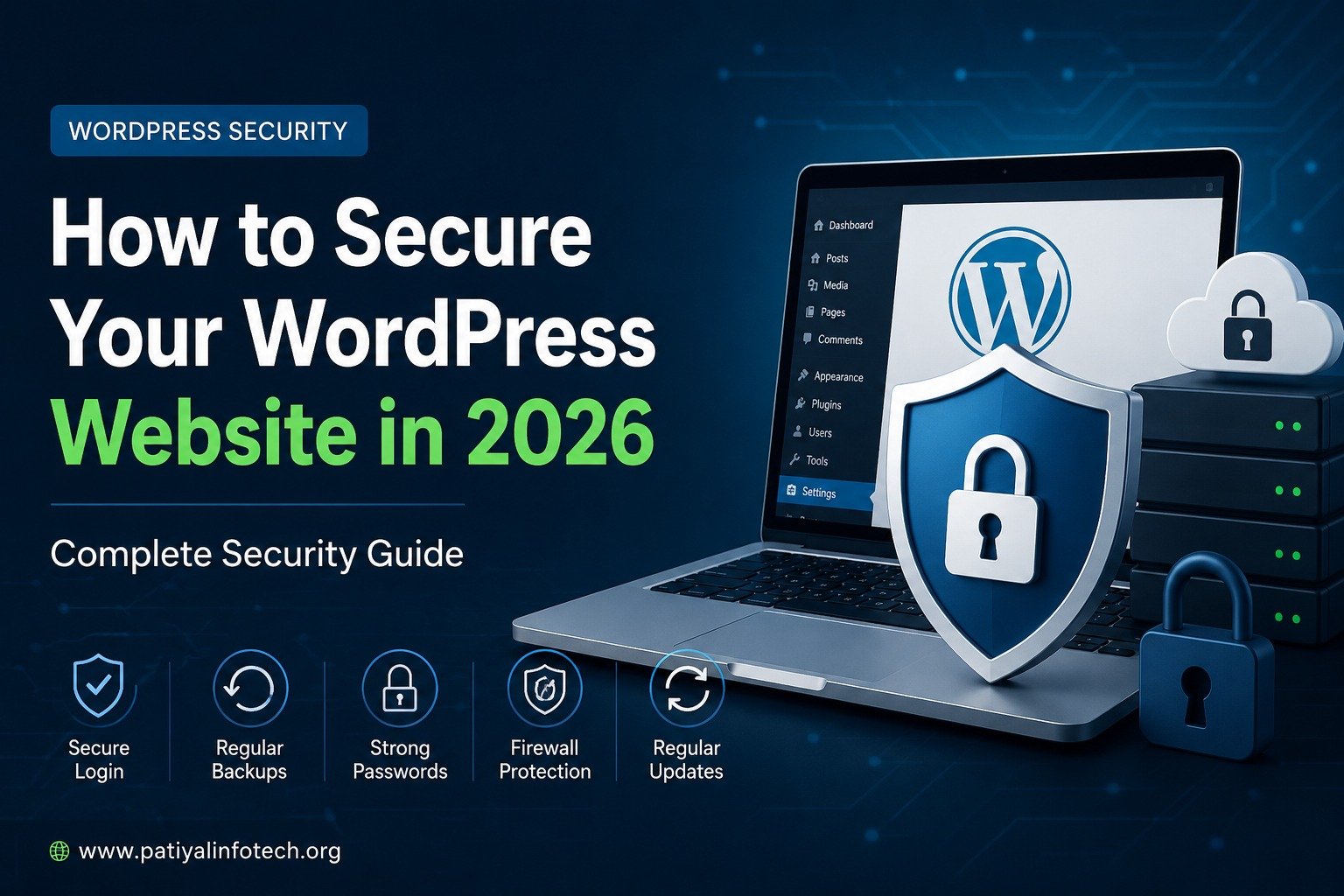
WordPress is one of the most popular platforms for building websites, blogs, business websites and online stores. Its flexibility makes it easy to create and manage a website, but it also means that website owners need to take security seriously.
A WordPress website can become vulnerable because of outdated plugins, weak passwords, insecure themes, poor hosting configuration, malware or unnecessary software.
The good news is that you do not need to be a security expert to improve your website’s protection.
In this guide, we will explain how to secure a WordPress website in 2026 using practical security measures that website owners and developers can follow.
1. Keep WordPress Updated
One of the simplest ways to improve WordPress security is to keep your website software updated.
This includes:
- WordPress core
- Plugins
- Themes
- PHP version
- Other server software where applicable
Developers regularly release updates to fix bugs, improve compatibility and address security vulnerabilities.
However, you should not blindly update everything on a busy production website. Take a backup first and, for important websites, consider testing major updates on a staging environment.
Best practice
Before updating:
- Take a fresh backup.
- Check plugin and theme compatibility.
- Update one component at a time when practical.
- Test important pages and forms after updating.
2. Remove Unused Plugins and Themes
Installing a plugin and simply deactivating it does not necessarily mean it should remain on your website.
Unused plugins and themes increase the amount of software that needs to be maintained.
If you are not using a plugin or theme, consider removing it after confirming that it is not required.
This is especially important for old plugins that are no longer maintained.
Avoid installing plugins just because they look useful
Before installing a plugin, ask:
- Do I really need this feature?
- Is the plugin actively maintained?
- Is it from a trustworthy source?
- Does it have good documentation?
- Could the same feature be implemented without another plugin?
A smaller, well-maintained plugin set is generally easier to manage.
3. Use Strong and Unique Passwords
Weak passwords are one of the easiest ways for attackers to gain access to an administrator account.
Never use passwords such as:
- 123456
- admin123
- Your company name
- Your website name
- Your phone number
Instead, use a long, unique password that is not used anywhere else.
You should also avoid sharing one administrator account between multiple people.
For a team, create individual user accounts and give each person only the permissions they actually need.
4. Enable Two-Factor Authentication
Two-factor authentication, commonly called 2FA, adds another layer of protection to your login.
With 2FA enabled, a username and password alone are not enough to access the account. The user must also provide an additional verification method.
This can be particularly valuable for:
- Administrator accounts
- Website owners
- Developers
- Hosting accounts
- Email accounts
If your security solution or authentication system supports 2FA, consider enabling it for administrator-level users.
5. Take Regular WordPress Backups
Even with strong security, no website can be guaranteed to be completely protected from every possible problem.
That is why backups are essential.
A proper WordPress backup should normally include:
- Website files
- WordPress database
- Important configuration files
- Uploaded media
Do not assume that a backup exists simply because your hosting company provides backups.
You should understand:
Where is the backup stored?
How frequently is it created?
How long is it retained?
Can it actually be restored?
A backup that has never been tested should not be treated as a guaranteed recovery solution.
6. Use SSL and HTTPS
Your website should use HTTPS rather than HTTP.
HTTPS helps protect information exchanged between the visitor’s browser and the website.
After installing an SSL/TLS certificate, make sure the entire website loads correctly over HTTPS.
Check:
- Homepage
- Internal pages
- Images
- Forms
- Login pages
- Checkout pages
- External resources
Also check for mixed-content warnings where some resources are still being loaded over HTTP.
7. Install a Reputable Security Solution
A reputable WordPress security solution can help monitor your website and identify suspicious activity.
Depending on the solution, security features may include:
- Malware scanning
- Login protection
- Firewall protection
- File monitoring
- Brute-force protection
- Security notifications
- IP blocking
However, installing a security plugin does not mean the website is automatically secure.
Security should be treated as a combination of:
secure hosting + updates + strong authentication + backups + monitoring + good website practices.
8. Protect Your Website From Brute-Force Attacks
A brute-force attack happens when automated systems repeatedly attempt to guess login credentials.
You can reduce this risk by using:
- Strong passwords
- Two-factor authentication
- Login rate limiting
- Firewall protection
- Proper user permissions
Avoid unnecessarily exposing administrator accounts or sharing login credentials.
If your website receives a large amount of malicious traffic, a firewall or CDN-based security layer can also help reduce unwanted requests before they reach your server.
9. Choose Reliable WordPress Hosting
Website security is not only a WordPress issue.
Your hosting environment also matters.
A good hosting provider should provide appropriate security controls, backups, current server software and reasonable resource isolation.
When choosing hosting, consider:
- Backup options
- SSL support
- PHP version availability
- Server security
- Malware monitoring
- Firewall/WAF options
- Account isolation
- Support quality
Cheap hosting is not always bad, but hosting should not be selected based on price alone.
10. Keep PHP Updated
WordPress runs on PHP, so the PHP version used by your hosting environment matters.
Older PHP versions can eventually become unsupported and may create security and compatibility concerns.
Before changing PHP versions on a production website:
- Create a backup.
- Check WordPress compatibility.
- Check theme compatibility.
- Check plugin compatibility.
- Test the website after changing the version.
For important websites, test the PHP upgrade on staging first.
11. Monitor Your Website for Malware
Sometimes a website can appear normal to the owner while malicious code or suspicious files are present in the background.
Possible warning signs include:
- Unexpected redirects
- Unknown administrator accounts
- Strange pop-ups
- Unfamiliar files
- Spam pages
- Sudden traffic changes
- Browser security warnings
- Unusual server usage
- Emails being sent without permission
If you notice something unusual, investigate it instead of simply deleting random files.
A proper malware cleanup may require checking the website files, database, users, plugins, themes and server environment.
12. Use a Web Application Firewall
A Web Application Firewall (WAF) can help filter malicious web traffic before it reaches your website.
Depending on the setup, a WAF can help protect against certain types of:
- Automated attacks
- Malicious requests
- Brute-force attempts
- Suspicious traffic
A CDN/WAF service can be particularly useful for websites receiving large amounts of unwanted traffic.
However, a WAF should be considered another security layer, not a replacement for keeping WordPress updated and maintaining backups.
13. Give Users Only the Access They Need
WordPress provides different user roles.
For example:
- Administrator
- Editor
- Author
- Contributor
- Subscriber
Do not give administrator access to every person who needs to edit content.
If someone only needs to publish blog posts, they may not need complete administrative access.
The principle is simple:
Give users only the permissions required to perform their job.
Also remove accounts belonging to people who no longer work on the website.
14. Be Careful With Free, Nulled and Pirated Plugins
Not every free plugin is dangerous. Many legitimate WordPress plugins are available for free.
The bigger concern is downloading themes or plugins from unknown websites, especially nulled or pirated versions of premium software.
Such files may contain unwanted or malicious code.
Always obtain plugins and themes from trustworthy sources.
Before installing software, check:
- Developer
- Update history
- Compatibility
- Reviews
- Documentation
- Support
- Source of the download
15. Secure Your WordPress Admin and Hosting Accounts
Protecting WordPress alone is not enough.
Your hosting account, domain account and business email can also provide access to your website infrastructure.
Enable strong authentication wherever available for:
- WordPress administrator accounts
- Hosting account
- Domain registrar
- Business email
- Cloud/CDN account
Use unique passwords and avoid sharing account credentials through insecure channels.
16. Review Website Security Regularly
Security should not be treated as a one-time task.
Create a simple monthly security routine.
Check:
- WordPress version
- Plugin updates
- Theme updates
- PHP version
- User accounts
- Security alerts
- Malware scans
- Backup status
- SSL certificate
- Hosting resources
- Suspicious files
- Website forms and important functionality
Regular checks can help identify problems before they become major issues.
WordPress Security Checklist for 2026
Before considering your website properly maintained, check the following:
- WordPress is updated
- Plugins are updated
- Themes are updated
- Unused plugins are removed
- Unused themes are removed
- Strong administrator passwords are being used
- Two-factor authentication is enabled
- Regular backups are available
- Backups have been tested
- SSL/HTTPS is working correctly
- PHP is supported and compatible
- Malware/security scanning is configured
- Firewall/WAF protection is considered
- Old user accounts are removed
- Administrator permissions are limited
- Hosting account is protected
- Domain account is protected
- Website is regularly monitored
What Should You Do If Your WordPress Website Is Hacked?
If you believe your website has been hacked, avoid making random changes without first understanding the problem.
A practical response can include:
- Take the website into maintenance mode if necessary.
- Create a backup or forensic copy before making major changes.
- Change compromised passwords.
- Check administrator accounts.
- Scan website files and database.
- Identify suspicious or modified files.
- Review recent plugin, theme and server changes.
- Restore from a known-clean backup when appropriate.
- Update vulnerable software.
- Check the website again after cleanup.
For business websites, e-commerce websites or websites containing sensitive information, professional assistance may be the safer option.
Final Thoughts
Securing a WordPress website is not about installing one security plugin and forgetting about it.
A secure website requires a combination of regular updates, strong authentication, reliable backups, secure hosting, malware monitoring and good maintenance practices.
The most important thing is consistency.
Spend some time reviewing your website security regularly instead of waiting until the website has already been hacked or stopped working.
A well-maintained WordPress website is easier to protect, troubleshoot and recover.
Frequently Asked Questions
Yes. WordPress can be used securely when it is properly maintained. Website security also depends on themes, plugins, hosting, passwords, user permissions and the way the website is managed.
Basic checks should be performed regularly, while updates, backups and security reviews should follow the activity and importance of the website. Business and e-commerce websites generally benefit from more frequent monitoring.
No. A security plugin can provide useful protection, but it cannot guarantee that a website will never be compromised. Security works best as a combination of secure hosting, updates, strong authentication, backups, monitoring and good maintenance practices.